Knowing Where to Go: Generalizing Mobile Manipulation to Unseen Environments from a Single Video
Abstract
Vision-language-action policies have achieved impressive mobile manipulation capabilities, but remain brittle in unfamiliar multi-room environments. We find that much of this brittleness stems from failures of spatial generalization: strong policies often resort to reactive exploration when task-relevant locations move outside familiar layouts. Oracle spatial guidance largely prevents this degradation. We study how spatial context from a prior environment walkthrough video should be represented to guide mobile manipulation policies under environment shift. We find that strong in-distribution spatial prediction can be a poor predictor of out-of-distribution transfer, while models that explicitly encode 3D structure generalize more robustly to new robot environments. Building on this, we develop a hierarchical policy that uses a single environment video to provide spatially grounded guidance to a VLA. We find that navigation performance of mobile manipulation policies is heavily bottlenecked by spatial understanding, and that our strongest policy more than doubles the placement rate of its flat counterpart (24.8% vs. 10.9%) in our hardest setup.
Spatial generalization in mobile manipulation
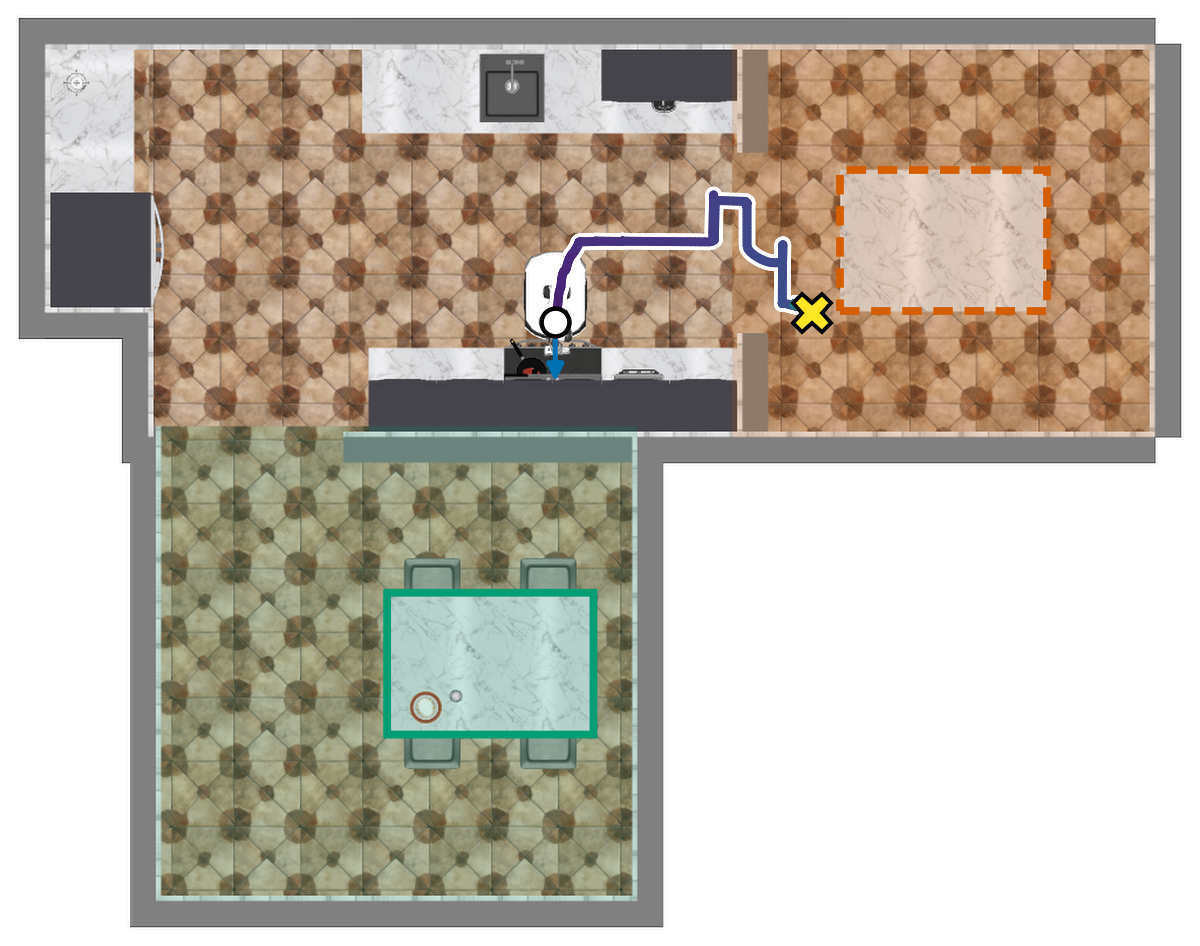
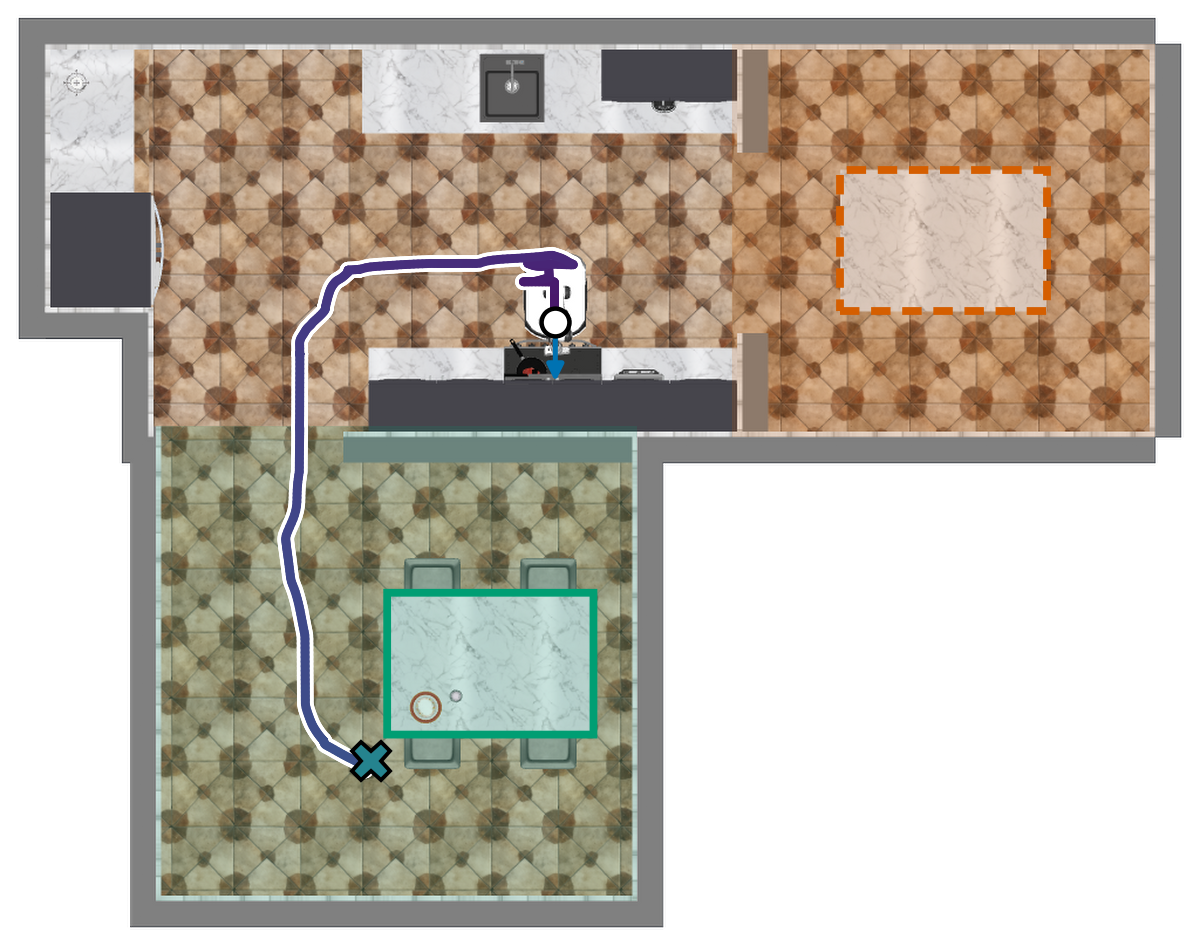
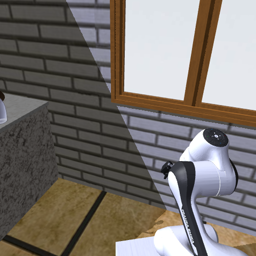
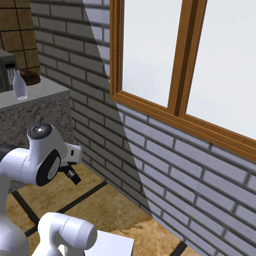
We probe mobile manipulation policies in unfamiliar multi-room layouts, where task-relevant locations are moved to a separate room and a decoy room is added. Strong reactive policies spend substantial time exploring irrelevant locations, and their placement rates decrease. A hierarchical π0.5 policy with ground-truth navigation goals degrades substantially less, indicating that spatial guidance can mitigate this failure without improving the underlying manipulation skills.
Flat VLAEnters the decoy room
The flat policy navigates into the room containing the decoy table.
VLA + oracle guidanceReaches the dining room
The oracle-guided policy navigates to the task-relevant dining table.
Motivating experiment, not our learned planner. These selected trajectory stills illustrate the paper's oracle comparison, for the task “Move the pan to the dining table.”
Dining tableDecoy table
Recorded rollouts
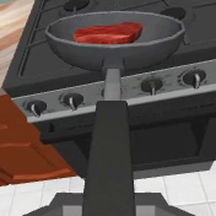
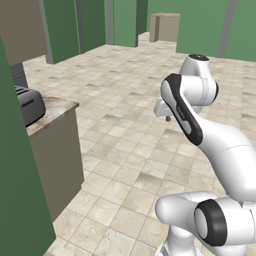
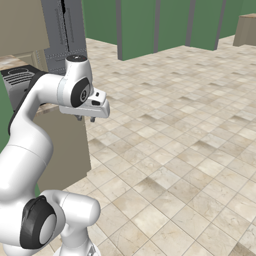
Task: Pick up the pan with the steak in it and place it on the dining table. Then place the steak on the plate.
XR-1
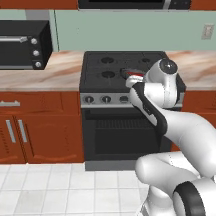
The robot explores the kitchen and decoy room but does not reach the dining room.
Flat π0.5
The robot enters the decoy room rather than the dining room.
π0.5 + oracle guidance
With ground-truth navigation guidance, the robot reaches the dining room but does not complete the task.
All three policies start from the same saved scene (ServeSteak, trial 1, Unseen-Hard). This episode was selected to show XR-1's movement through the scene; it is not a random sample or an aggregate performance comparison. All head-camera recordings are shown at 4× speed. The players are independent. The oracle policy is a privileged probing baseline, not the learned spatial planner.
Spatially grounded hierarchical policy
A high-level VLM planner conditions on a prerecorded environment tour, current egocentric observations, and the task instruction. It predicts subtask instructions and, for navigation subtasks, a binned polar hint specifying the target's distance and bearing relative to the robot base. A low-level π0.5 VLA predicts actions from the subtask, current egocentric observations, and proprioception, without receiving the tour directly.
Planner
“navigate to the plate (2.0 m, 0.00 rad)”
Spatial VLM
Spatial context from offline video
Ego
“Pick up the pan with the steak … place it on the dining table …”
Task
Executor
Actions at:t+H
VLA
“navigate to the plate (2.0 m, 0.00 rad)”
Subtask
Ego
Proprio
The planner receives spatial context from an offline video and predicts subtask instructions with navigation hints. The executor receives the subtask, egocentric observations, and proprioception, and predicts actions. The example instruction is illustrative.
In the Q3D variant, tour depth and camera poses lift the views into a point cloud. In the estimated-geometry setting, Depth Anything 3 estimates depth and poses from RGB, and a SLAM-style module relocalizes current views against the tour reconstruction during execution. The ground-truth geometry variant instead receives simulator depth and camera poses.
Sample environment tours
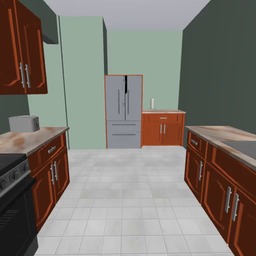
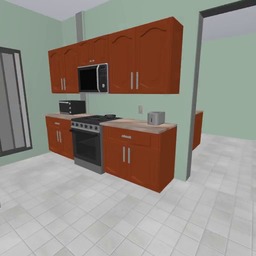
Before task execution, the planner receives a single prerecorded tour of the environment. These examples show the visual context available in each evaluation setting; they are not robot task rollouts.
Seen
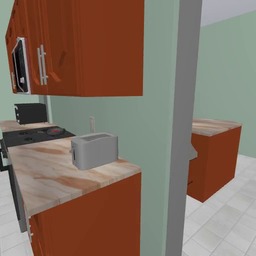
A training kitchen, with all task-relevant objects in the kitchen.
Unseen-Easy
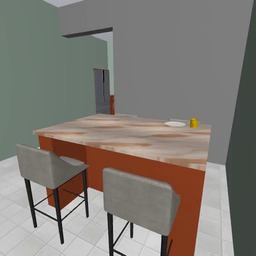
A new layout, with the dining table moved into a separate room.
Unseen-Hard
A new layout with a separate dining room and an additional room containing a decoy table.
Selected ServeSteak tours: trial 1 in Seen and Unseen-Easy, and trial 16 in Unseen-Hard. Each six-second tour is shown at its original playback speed. The rollout videos above remain at 4× speed.
Controlled study of spatial representations
We instantiate spatial learning recipes with a Qwen3-VL-4B backbone, a shared data mix, and a fixed gradient-step budget. Models are trained to predict target bearings from a tour and egocentric query views. Geometric supervision and features improve spatial prediction, but in-distribution accuracy does not reliably predict transfer to RoboCasa. Among tour-conditioned models, Q3D has the lowest bearing accuracy on held-out MolmoSpaces houses and the highest on the target RoboCasa layouts.
Training and evaluation examples
Here we visualize examples from both the training and evaluation datasets, highlighting the robot's tour context and current query views. On the left, we visualize a sample from the MolmoSpaces-generated training data. On the right, we visualize a sample from the RoboCasa evaluation data.
MolmoSpaces · training data
Tour context
Current query views
Left shoulderRight shoulder
Question
In which direction is the vase, relative to the robot's current forward axis?
Ground-truth bearing
179.3°; nearest 16-bin label: 180° (behind).
RoboCasa · evaluation data
Tour context
Current query views
Left shoulderRight shoulder
Question
In which direction is the plate in the adjoining dining room, relative to the robot's current forward axis?
Ground-truth bearing
45.0°; nearest 16-bin label: 45° (ahead and to the left).
Both examples pair an earlier environment tour with the robot's current views. The model must use the tour to infer the direction to an object that is now out of sight: a vase in the MolmoSpaces training example and a plate in the RoboCasa evaluation example.
A
Implicit spatial learning
Learn spatial relationships from RGB video and question-answer supervision.
CS · Cambrian-S styleB
Geometric supervision / features
Encourage geometry through camera-pose prediction or geometry-aware input features.
CP · Cambrian-P style / V3R · VLM-3R styleC
Explicit 3D representation
Represent the scene as a point cloud with 3D positional encodings.
Q3D · Qwen-3D style
Bearing prediction results
Bearing accuracy (%) for selected models. Q3D uses ground-truth tour geometry in this spatial study; these are not robot placement rates. The comparison does not establish that explicit 3D inputs are universally superior: finetuning and generalization remain factors in the observed differences.
Spatial bearing prediction accuracy for selected midtrained models
Evaluation distribution
CS
V3R
Q3D
Held-out MolmoSpaces houses
70.3
72.0
46.7
RoboCasa · Easy
45.0
50.2
67.0
RoboCasa · Hard
39.3
40.1
56.5
Mobile manipulation evaluation
We evaluate ten navigation-heavy tasks in an unseen multi-room extension of RoboCasa365. Each setting contains 200 episodes, with 20 episodes per task. All tour-conditioned planner variants share the same low-level executor, allowing us to study the effect of the planner's spatial representation on downstream control.
01
Seen
Training kitchens; task-relevant locations remain in the kitchen.
02
Unseen-Easy
New layouts move the dining table to a connected, separate room.
03
Unseen-Hard
An additional room contains a decoy table, creating an ambiguous navigation choice.
Placement rate
200 episodes per setting · 10 tasks × 20 episodes
Flat π0.5Baseline
10.9%
Qwen3D policyEstimated geometry
24.8%
Qwen3D policyGround-truth geometry (privileged)
32.5%
0%25%50%
In Unseen-Hard, Qwen3D with estimated geometry achieves 24.8% versus 10.9% for the flat policy: a 13.9 percentage-point gain.
What is placement rate? The fraction of a task's required placements completed, averaged over episodes. It is not full-task success. Ground-truth tour geometry is privileged information, shown separately from the RGB-based method.
See all planner comparisons +
Placement rate (%) by method and evaluation setting
Method
Seen
Unseen-Easy
Unseen-Hard
Flat π0.5
41.6
20.4
10.9
Hierarchical π0.5, no navigation hint
38.9
21.3
13.0
Stock Qwen3-VL-4B planner
30.8
23.6
13.6
CS planner
33.9
18.9
13.0
CP planner
38.1
26.7
17.8
V3R planner
36.7
26.9
18.6
Q3D planner, estimated geometry
37.0
27.6
24.8
Q3D planner, ground-truth geometry (privileged)
36.3
34.4
32.5
Paired planner rollouts
We visualize rollouts on the ServeSteak task from three hierarchical policies with different planners and a shared low-level executor. In the videos, we add a red overlay when the planner predicts an inaccurate navigation hint. We observe that stock Qwen3-VL and VLM-3R-based planners predict incorrect hints, leading the robot to enter the decoy room. At the same time, the Q3D planner with privileged ground-truth tour geometry provides accurate hints, allowing the robot to reach the correct room.
These rollouts illustrate how a spatial prediction error can become a navigation failure: the executor follows the planner's instruction, but travels to the wrong room. In this matched comparison, more accurate spatial guidance allows the same executor to complete the task, illustrating why navigation-hint quality matters for mobile manipulation.
Stock Qwen3-VL
Enters the decoy room rather than the dining room.
VLM-3R
Follows an incorrect forward-bearing hint into the decoy room and never reaches the dining room.
Q3D · GT geometry (privileged)
Reaches the dining room and completes the task.
Unseen-Hard rollouts with the original predicted subtasks, shown at 4× speed. Red tint means the predicted navigation bearing differs by more than one 22.5 degree bin from ground truth.
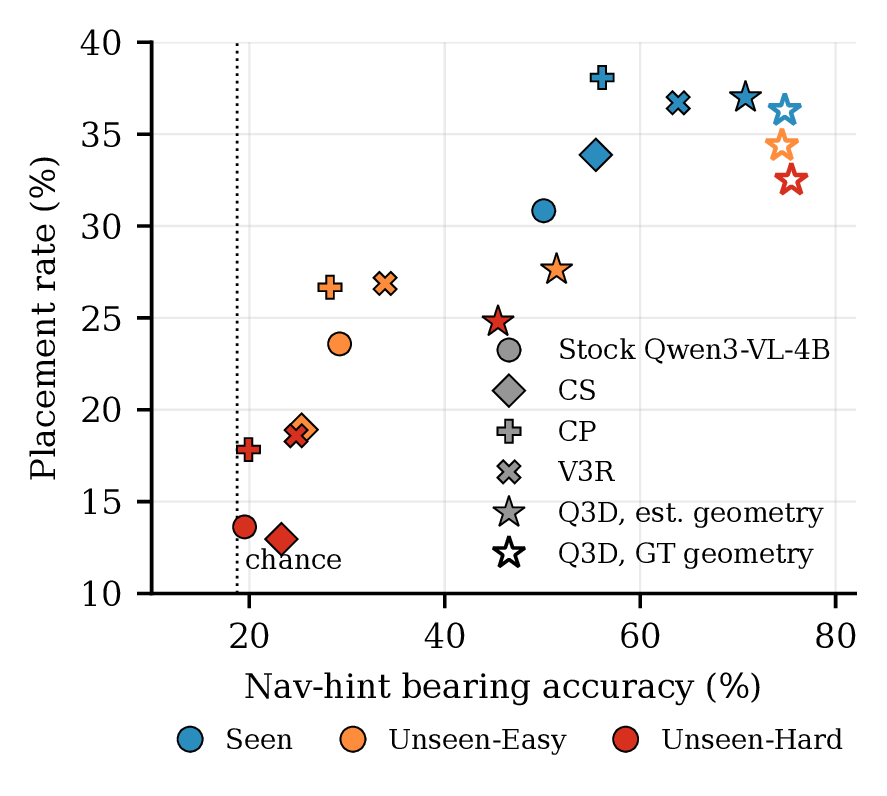
Navigation-hint accuracy and placement rate
Hover, tap, or focus a point to inspect its results. Select a point with Enter or Space. The matching Unseen-Hard examples link to the videos above.
Navigation-hint bearing accuracy during rollouts versus placement rate across 18 planner-setting pairs (Pearson r = 0.89). A prediction is counted as correct when it is within one angular bin of the ground-truth bearing (16 bins total), over all VLM navigation queries. The dotted line marks chance accuracy (18.8%). Filled stars use estimated geometry; open stars use privileged ground-truth tour geometry. Higher hint accuracy is associated with better downstream mobile manipulation performance.
Summary of findings
In Unseen-Hard, Q3D with estimated geometry achieves a placement rate of 24.8%, compared with 10.9% for the flat policy trained on the same robot data. It retains 67% of its Seen placement rate, whereas the flat policy retains 26%. Hierarchy alone, or a tour-conditioned planner without spatial midtraining, does not produce a comparable improvement.
Navigation-hint bearing accuracy during rollouts is correlated with placement rate (Pearson r = 0.89 across 18 planner-setting pairs). Q3D reaches 32.5% placement rate with ground-truth geometry, 7.7 percentage points above the estimated-geometry variant in Unseen-Hard. This gap suggests that recovering accurate geometry from RGB remains an important bottleneck.
Takeaways
Our experiments in simulated multi-room environments support the following conclusions.
Spatial generalization is a bottleneck for mobile manipulation.
Strong local navigation and manipulation skills do not by themselves provide knowledge of task-relevant locations in unfamiliar layouts. Oracle spatial guidance substantially reduces the degradation under layout shift, suggesting that scaling robot data alone may not be sufficient.
In-distribution spatial accuracy does not reliably predict transfer.
Models with strong bearing prediction on held-out houses from the midtraining distribution can transfer poorly to RoboCasa. Explicit 3D representations transfer most robustly in our study, supporting evaluation of spatial models on new environments and downstream behavior rather than only on their training distribution.
More accurate navigation hints are associated with better robot performance.
Hint accuracy during rollouts closely tracks placement rate (Pearson r = 0.89). With geometry estimated from the tour, the hierarchical Q3D policy achieves 24.8% placement rate in Unseen-Hard, compared with 10.9% for the flat policy trained on the same robot data.
Reconstructing accurate geometry remains an important bottleneck.
Ground-truth tour geometry raises Q3D's Unseen-Hard placement rate from 24.8% to 32.5%. This privileged comparison indicates substantial room to improve the spatial structure recovered from RGB video.